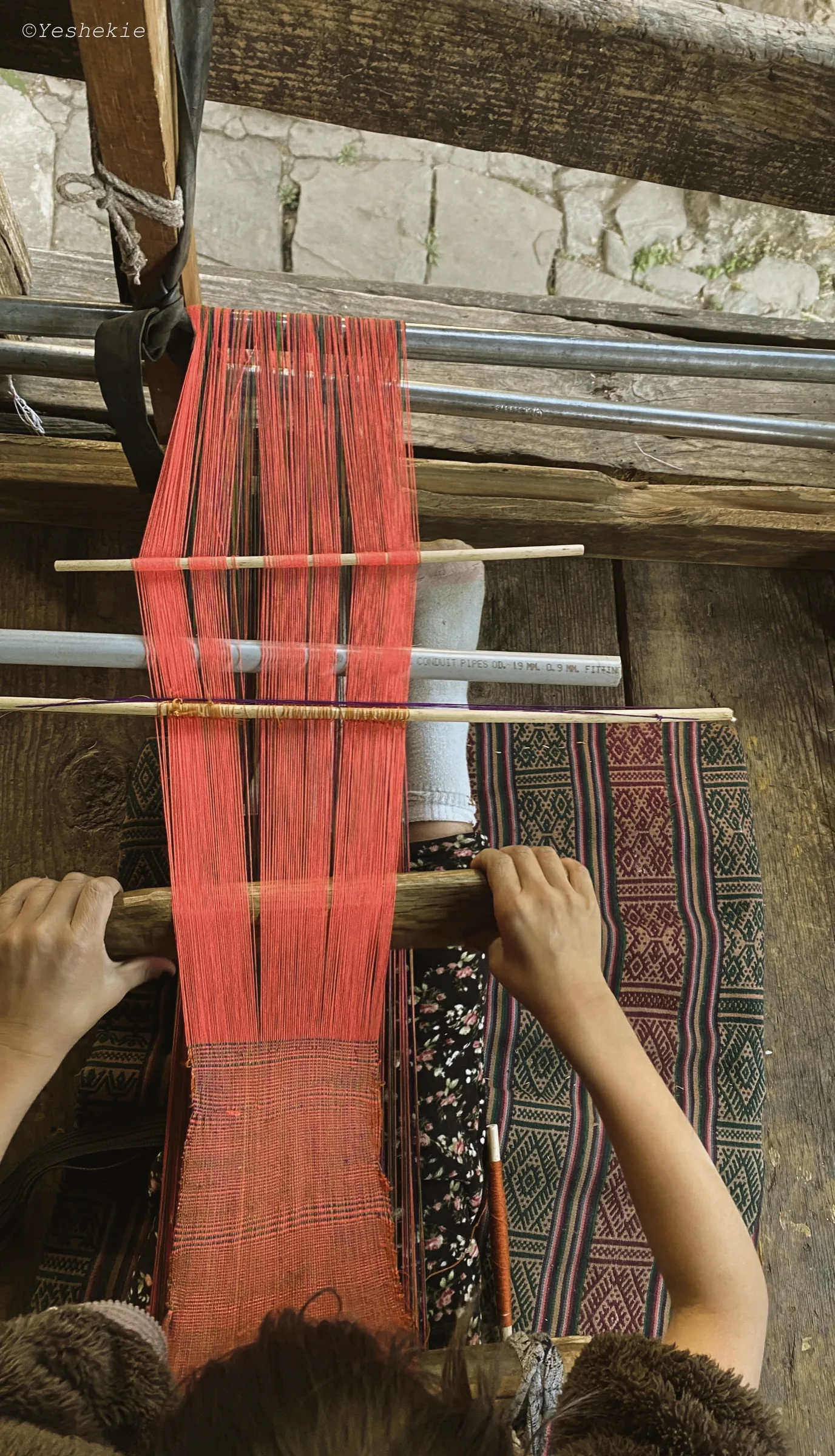
At dawn a collective thumping sound echoes through the village. As the roosters wake Khoma, in Lhuntse, the back-strap looms begin, and with them a rhythm the community has kept for generations.

Here weaving is women's work and women's knowledge. The national dress, the Gho for men, the Kira for women, is woven on these looms, binding the craft to Bhutan's sense of itself. To wear it is to wear something made by hand, at home.
Kishuthara
Khoma is known for Kishuthara: a silk-on-silk technique in which supplementary weft patterns are floated with extra yarns over a constructed base. It is slow, exacting work, a single Kira can take the better part of a year. The method is said to have travelled with the Chinese princess Wencheng in the seventh century, carried across mountains and kept alive at the loom.


Sither Lhamo
Sither Lhamo is eighty-six. She has woven for as long as she can remember, and weaving has become indistinguishable from who she is. The loom is not income so much as continuity, a way of holding knowledge and passing it on.
“I was going to stop weaving because I am old, yet I always find myself preparing another loom.”


The looms in Khoma do not fall silent. Work is shared, sessions overlap, and the thumping carries from house to house, the sound of a craft, and a community, keeping time.